Home Theatre Speaker Placement Guide: 5.1, 7.1 & Dolby Atmos
Start at the ears, screen and seats—then place each channel by role. Use the room planner to visualize a layout before walls, furniture or ceiling services lock it in.
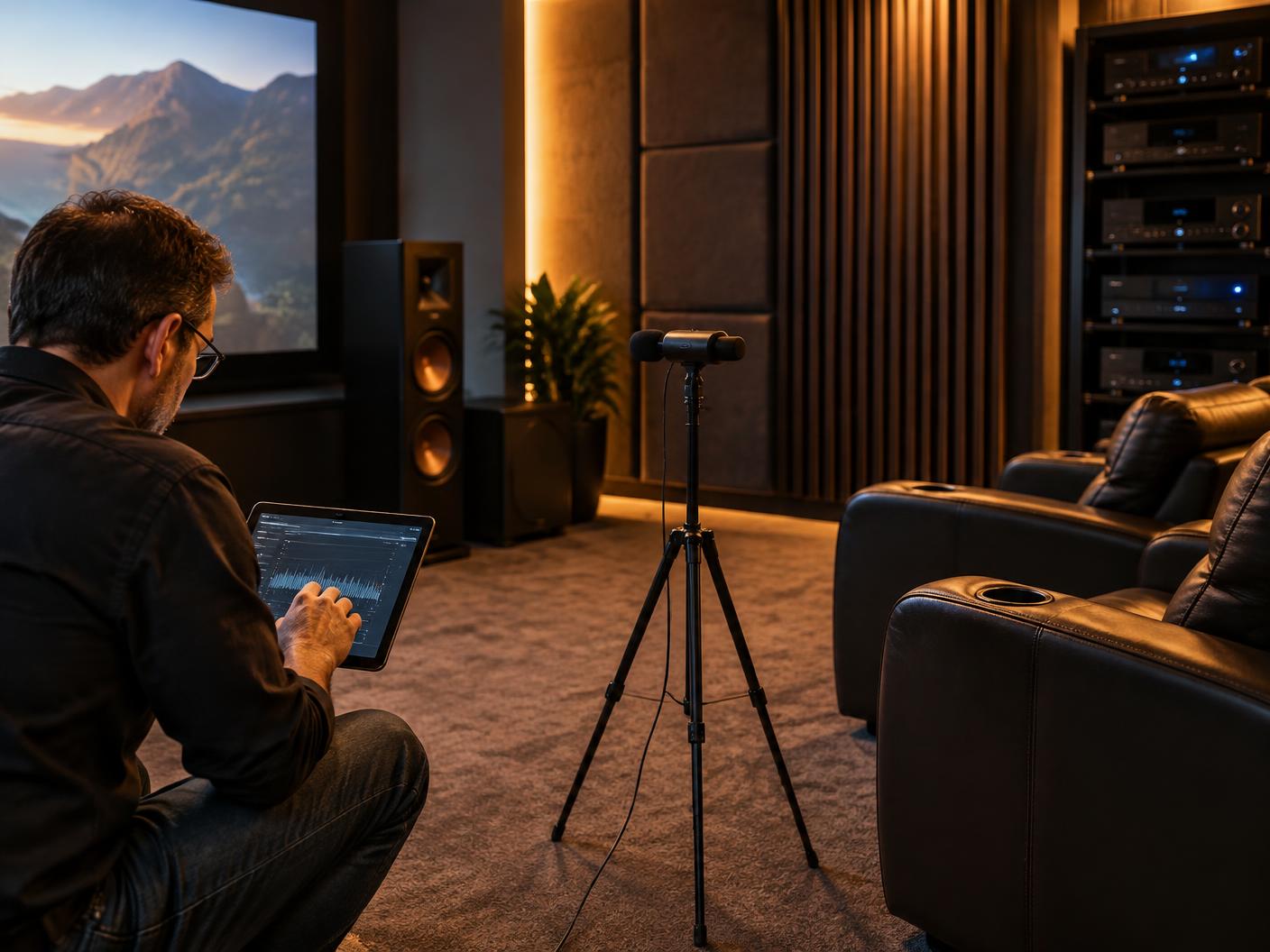
Final placement is verified through geometry, measurement and listening.
Where should home theatre speakers go?
Place speakers relative to the listening area, not arbitrary room corners. The screen and primary seats establish the front stage; side and rear channels need useful angular separation; height speakers need vertical separation from ear-level channels; and subwoofer positions must be tested against the room. Manufacturer layout drawings are reference guidance, while the final plan must account for speaker design, furniture and multiple seats.
Interactive planning tool
Map a practical speaker layout
Enter the room and layout you are considering. The visual shows channel roles around the main listening area—not final construction coordinates.
Enter 2–20; decimals are accepted.
Enter 2–15; decimals are accepted.
Enter 2–6; decimals are accepted.
Enter 1–30; decimals are accepted.
5.1 Speaker Placement
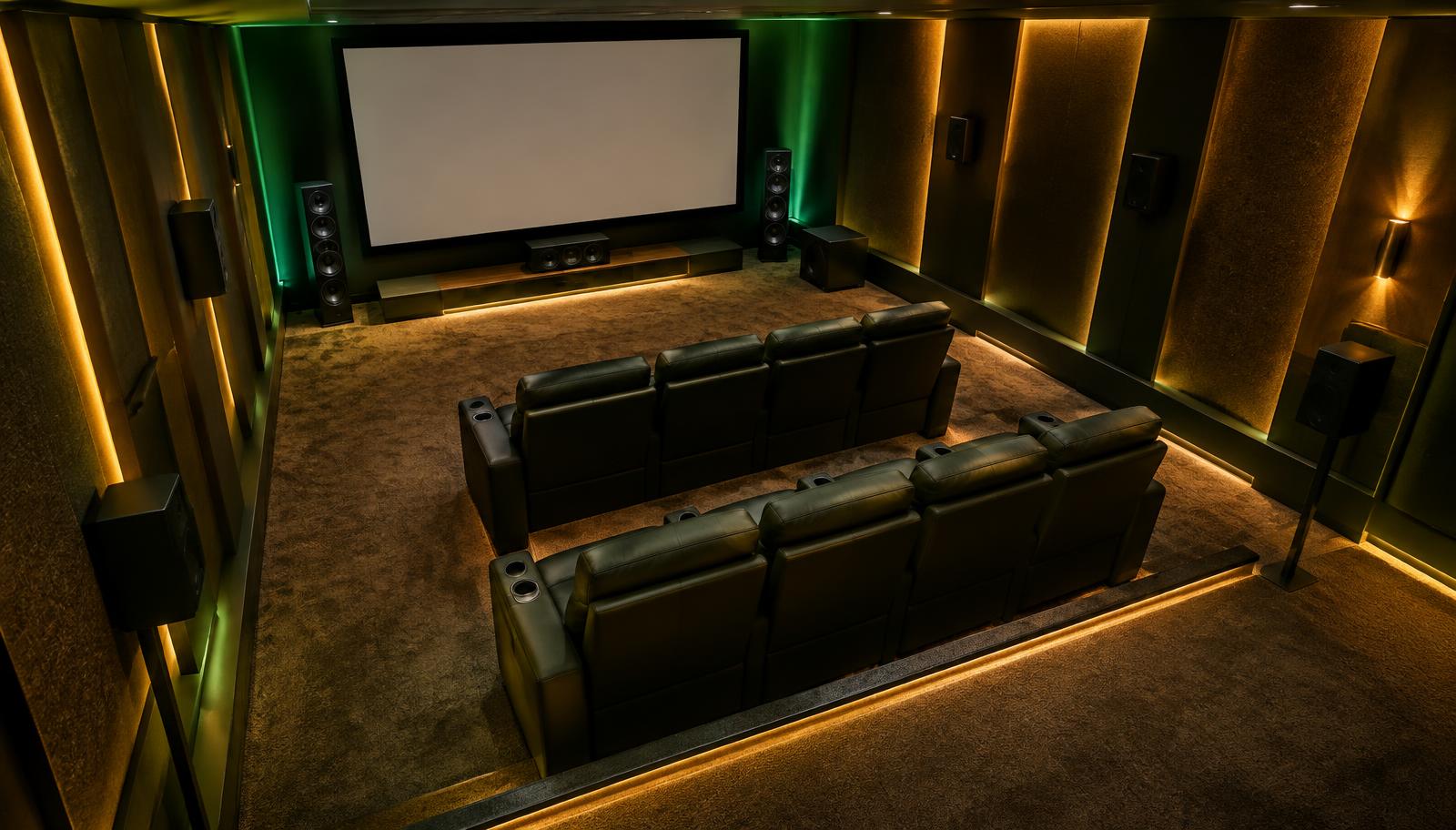
A 5.1 room uses left, centre and right across the screen wall, two surrounds around the listening area and managed bass. Keep the front stage coherent with the picture, avoid hiding the centre, and prevent one surround from dominating an end seat. Current Dolby 5.1 diagrams can be used as reference ranges, but room openings and speaker dispersion may require adjustment.
Channel
Role
Placement check
Front L/R
Music, effects and screen width
Balanced around the screen and aimed for stable imaging
Centre
Dialogue and screen-centred action
Close to picture height and aimed toward listeners
Surround L/R
Ambient field and side/rear movement
Related to seats, not ceiling corners
Subwoofer
Managed low-frequency effects
Test positions for smoother bass across seats
7.1 Speaker Placement
A 7.1 layout separates side surrounds from rear surrounds. This can improve rear directionality when the seats have enough space behind them. If the sofa touches the rear wall, forcing two rear channels into that boundary rarely produces the intended separation; a stronger 5.1 plan may be the better design.
5.1.2, 5.1.4 and 7.1.4 Height Layouts
Atmos adds a vertical layer without replacing side or rear surrounds. Use the current Dolby diagram for the selected implementation and calculate from the listening position. 5.1.2 uses one height pair; 5.1.4 and 7.1.4 use front and rear height pairs. For the complete format and receiver chain, read the Dolby Atmos guide.
Centre Speaker Placement
Keep dialogue acoustically connected to the picture. Place the centre as close to screen height as practical, aim it at seated ear level if it must sit above or below, and keep the front edge clear of shelves. An acoustically transparent screen can allow three matching front speakers behind the image.
Front Left and Right Placement
Symmetry, separation, distance from boundaries and toe-in work together. Start from the listening position and the manufacturer’s dispersion guidance rather than copying one fixed distance. Excessive toe-in can narrow the stage; too little separation can collapse the image toward the centre.
Side and Rear Surround Placement
Surrounds should cover the listening area without drawing attention to one nearby box. Multiple seats may require wider-dispersion designs, careful height and level compromises, or more than one measurement position. Rear surrounds belong behind the seats; they are not simply additional side speakers.
Ceiling Speaker Placement
Height speakers need clear audible separation from the ear-level layer. Check joists, ducts, lights, fans, ceiling treatment, speaker back-boxes and safe service access before marking cut-outs. Where angles are referenced, treat them as current manufacturer guidance measured from the listener—not universal construction coordinates.
Where to Place the Subwoofer
Low frequencies interact strongly with room dimensions and boundaries. A visually convenient corner may produce a peak at one seat and a cancellation at another. Test candidate locations, use measurement where possible and treat the subwoofer crawl as an exploratory technique rather than a guarantee.
When Multiple Subwoofers Help
Two or more subs are often used to improve consistency across several seats. Their benefit depends on placement, delay, level, polarity and correction. More physical subwoofers do not automatically mean more independent LFE channels or better bass.
Room Type Changes the Compromise
Living rooms must work around furniture, openings and daily use. Bedrooms and compact media rooms often favour 3.1, 5.1 or 5.1.2. Dedicated rooms allow hidden wiring and repeatable geometry, while large or multi-row theatres need broader coverage, careful delay and bass consistency.
Speaker Placement for Two Rows
Choose a primary listening region rather than optimizing one chair while neglecting the second row. Check sightlines, head clearance, surround coverage, height-layer geometry and bass variation. The final calibration should sample representative seats and document the compromise.
Acoustics and Placement Are Connected
A speaker near glass, a bare side wall or a deep cavity can behave differently from its partner. Treatment can control first reflections and decay, but it should follow a layout plan. Read the room acoustics guide before interiors are finalized.
Speaker Wiring Before Construction
Coordinate cable, conduit, ceiling points, wall reinforcement, subwoofer signal and power, service loops, access panels and future paths. Photograph and label concealed routes before closure. The wiring guide provides a broader infrastructure checklist.
Common Placement Mistakes
The most common failures are geometric, not expensive-equipment problems.
Centre speaker blocked by cabinetry
Front stage squeezed around a screen without useful width
Surrounds mounted far above the listeners
Rear surrounds added when seats touch the back wall
Height channels placed without reference to seating
Subwoofer chosen by convenience without testing
No allowance for fans, ducts, lights or access
Calibration attempted before polarity and channel assignment checks
Experience Centre · Hyderabad
Visit our Hyderabad showroom
Book a free demo at the LiveInSmart Hyderabad Experience Centre — listen to Dolby Atmos, see 4K laser projectors and walk through live home-automation scenes before you buy.
Pancom Business Centre, Mumbai Hwy, Nagarjuna Nagar Colony, Ameerpet, Hyderabad 500073
As close to picture height as practical, clear of cabinet edges and aimed toward seated ear level when it is above or below the screen.
Where should 5.1 speakers be placed?+
Left, centre and right relate to the screen; surrounds relate to the sides of the listening area; the subwoofer position is tested against room response.
Where should 7.1 speakers go?+
Use side surrounds around the listening area and rear surrounds behind it. The room needs genuine space behind the seats.
Where should Atmos ceiling speakers go?+
Their positions depend on the selected Dolby layout and the listening position. Use the current setup drawing and confirm construction constraints before cutting.
How high should surround speakers be?+
Follow the speaker and format guidance while preserving audible separation from height channels. Avoid treating one universal height as correct for every room.
Where should I place the subwoofer?+
Test practical locations and compare response at the seats. Boundary positions alter output and smoothness, so appearance alone should not decide.
Can speakers be placed behind the sofa?+
Rear surrounds can, when there is adequate distance. Side surrounds and a sofa against the back wall require a different compromise.
Should front speakers be angled toward the listener?+
Often, but the degree depends on speaker dispersion, distance and desired stage width. Begin with manufacturer guidance and verify by listening.
Can I install Atmos speakers in a false ceiling?+
Potentially, after checking structure, depth, back-box needs, services, safe mounting and access.
How do I place speakers in a long room?+
Preserve front-stage geometry, evaluate whether rear surrounds have useful space, and verify coverage and bass across the seating area.
How should speakers be placed for two rows?+
Design for a listening region, check surround and height coverage for both rows, and calibrate representative seats.
Does placement matter more than speaker price?+
Placement and room interaction can determine whether a capable speaker performs coherently. Higher price cannot compensate for blocked or inappropriate geometry.
Map every speaker to your actual seats?
Share the room, screen wall, ceiling and intended layout. LiveInSmart can turn the planning view into a coordinated installation drawing.