
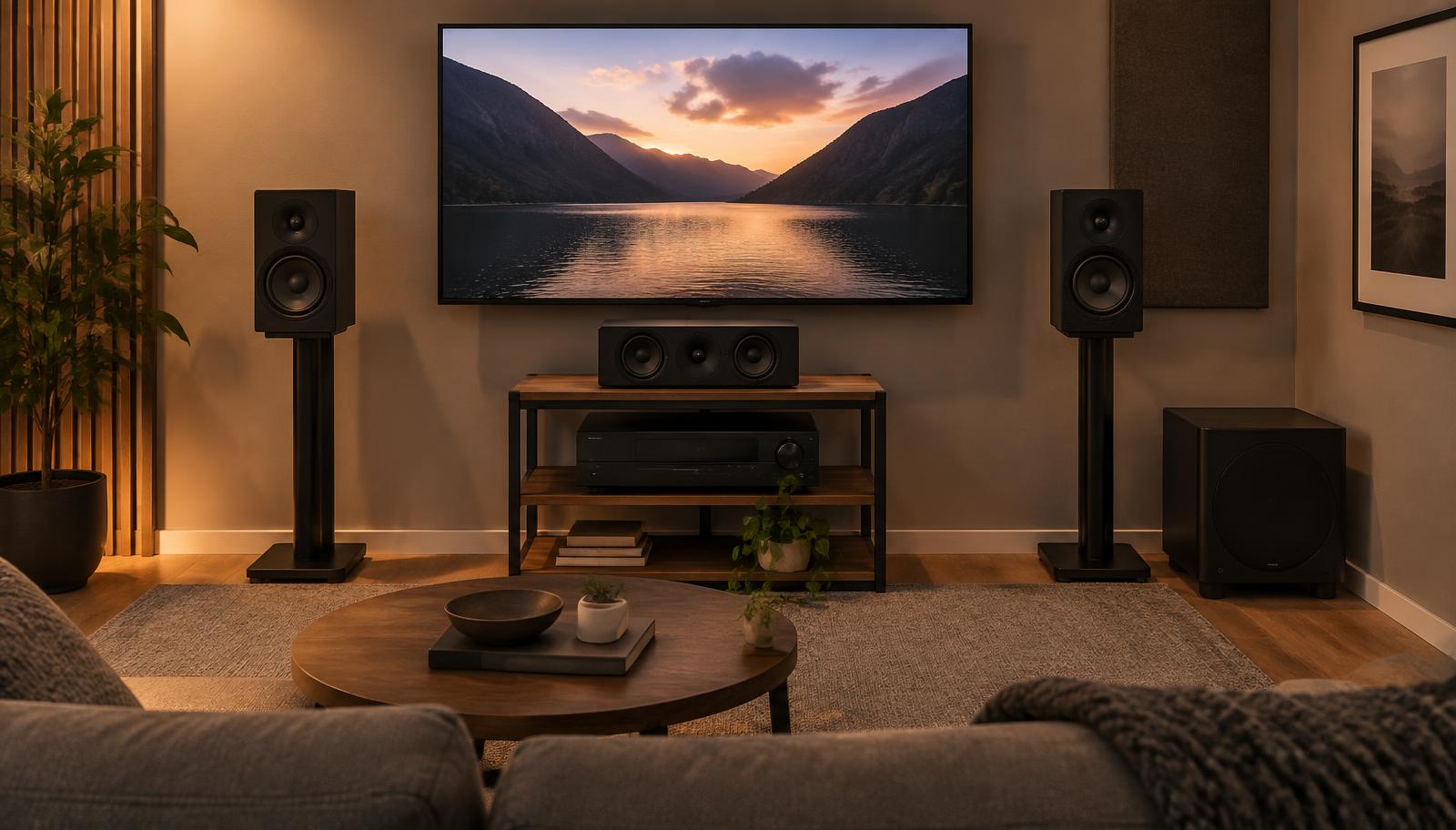
Compact media room with bookshelf speakers on stands, centre channel, subwoofer and AV receiver
    Polk Audio · Category

    Polk Bookshelf Speakers

    A bookshelf speaker is often the more realistic choice in an Indian apartment living room than a tower, provided the stands, the height and the crossover are planned rather than improvised. This page compares the published specifications and explains where each role fits.

    What are Polk bookshelf speakers?

    Polk bookshelf models serve three roles: a stereo pair, the front left and right of a compact system, or the surround channels of a larger one. They need a stand or bracket at the right height and a subwoofer to cover what the cabinet cannot, and their performance depends heavily on what they are placed on.

    What Bookshelf Speakers Do in a System

    A bookshelf speaker trades low-frequency extension for placement flexibility and, in a small room, often better coherence. Used as fronts it needs a subwoofer crossed over higher than a tower would be. Used as surrounds it needs to be tonally related to the fronts and positioned at the right height beside the seats.

    Polk Bookshelf Speakers Compared

    Values below are Polk's own published figures. Where a specification is not published, the cell reads "Specification currently being verified" rather than carrying an estimate. Each model has its own page with the full specification set, system role and installation notes.

    Manufacturer-published specifications, compared side by side
    ModelSeriesDriversFrequency responseSensitivityDetail page
    ES20Signature Elite1 × 1" Terylene dome tweeter, 1 × 6.5" mica-fortified polypropylene woofer44 Hz – 40 kHz88 dBView
    ES15Signature Elite1 × 1" Terylene dome tweeter, 1 × 5.25" mica-fortified polypropylene woofer48 Hz – 40 kHz88 dBView
    R200Reserve1 × 1" Pinnacle Ring Radiator tweeter, 1 × 6.5" Turbine Cone woofer39 Hz – 50 kHz overall; 51 Hz – 38 kHz (−3 dB)86 dB (2.83 V / 1 m)View
    R100Reserve1 × 1" Pinnacle Ring Radiator tweeter, 1 × 5.25" Turbine Cone woofer44 Hz – 50 kHz overall; 58 Hz – 39 kHz (−3 dB)86 dB (2.83 V / 1 m)View
    XT20Monitor XT1 × 1" Terylene dome tweeter, 1 × 6.5" bi-laminate paper woofer38 Hz – 40 kHz87 dB (1 W / 1 m)View
    XT15Monitor XT1 × 1" Terylene dome tweeter, 1 × 5.25" bi-laminate paper woofer48 Hz – 40 kHz86 dB (1 W / 1 m)View
    T15T Series1 × 0.75" silk/polymer composite dome tweeter, 1 × 5.25" mineral-filled composite mid/woofer60 Hz – 24 kHz; 65 Hz – 20 kHz (−3 dB)89 dB (1 W / 1 m)View

    How We Choose Between Them

    Selection is a room decision. These are the factors we work through before suggesting a model, in this order:

    • Decide the role first. Front duty and surround duty lead to different size choices even inside the same range.
    • Confirm there is somewhere to put them. A bookshelf speaker inside a closed shelf is not the same speaker as one on a rigid stand.
    • Check the crossover consequence: the higher a speaker's low-frequency limit, the higher the subwoofer has to be crossed over, and the easier the subwoofer becomes to locate by ear.
    • Match the tweeter family to the centre channel and fronts if the speaker is joining an existing system.
    • For wall mounting, confirm the model supports a bracket and that the wall can take the load at the required height.

    Placement and Calibration

    Tweeters at seated ear height, on rigid stands, clear of the rear wall, and toed in toward the seats. As surrounds, mount them slightly above ear height beside or just behind the seating, aimed across the listening area rather than at one head. Isolation pads under the speakers reduce the cabinet vibration that a shelf or media unit otherwise transmits.

    Common Mistakes We Are Called In to Fix

    Most of the rooms we are asked to correct have the right equipment installed the wrong way. These are the recurring ones:

    • Placing them inside a TV unit, then trying to fix the resulting thickness with equalisation.
    • Using lightweight stands that flex, which blurs everything the cabinet is doing well.
    • Crossing over too low because the specification looks generous — the published limit is not the level at which the speaker plays that frequency cleanly.
    • Mounting surrounds in high rear corners because that is where the wall was free.

    Individual Model Pages

    Each page lists manufacturer-published specifications, the model's role in a system, room and placement considerations, receiver matching and installation guidance.

    How LiveInSmart Reviews This Information

    Specifications on this page are taken from Polk Audio's own published product information and are re-checked before each content update. Where a value is not published by the manufacturer, we leave it out rather than estimate it — you will see "Specification currently being verified" instead of a guessed number. Everything else on this page is LiveInSmart's own system-design and installation guidance, written by the engineers who commission these rooms.

    • LiveInSmart Technologies is an authorised Polk Audio dealer in Telangana and Andhra Pradesh, and a home theatre, AV, acoustics and smart-home integrator working across both states since 2018.
    • Our authorised-dealer status applies to Polk Audio in Telangana and Andhra Pradesh. Product recommendations still begin with the room, listening requirement and system design rather than a catalogue.
    • Speaker choice is always validated against the room: dimensions, listening distance, seating layout, ceiling construction, amplification and acoustic treatment.
    • Our commissioning routine includes level and distance setting, crossover and bass management, subwoofer positioning, room correction and a listening check with reference material.
    • Experience centres in Ameerpet (Hyderabad) and Ashok Nagar (Vijayawada) let you hear layout differences before committing to a design.
    Experience Centre · Hyderabad

    Visit our Hyderabad showroom

    Book a free demo at the LiveInSmart Hyderabad Experience Centre — listen to Dolby Atmos, see 4K laser projectors and walk through live home-automation scenes before you buy.

    Pancom Business Centre, Mumbai Hwy, Nagarjuna Nagar Colony, Ameerpet, Hyderabad 500073

    Frequently Asked Questions

    Are bookshelf speakers good enough for home theatre?+

    Yes, with a subwoofer and correct crossover settings. In a small or medium room they often integrate better than a tower that is too large for the listening distance.

    Do bookshelf speakers need stands?+

    For front duty, effectively yes. Height and rigidity change the result more than most component upgrades. Surrounds can be wall-mounted on suitable brackets.

    Can I use bookshelf speakers as surrounds with floorstanding fronts?+

    That is the most common configuration. Keep them within the same Polk family as the fronts so the tonal character stays consistent as sound pans around the room.

    What crossover should I set?+

    Set it by measurement against the speaker's actual in-room response, not from the specification sheet. A common starting point is well above the published low-frequency limit, then refined during calibration.

    Can they be placed on the wall?+

    Only with a bracket designed for the model and a wall that can carry it. Wall proximity adds bass reinforcement that room correction then has to manage.

    Design a Polk Audio System For Your Room?

    As an authorised Polk Audio dealer in Telangana and Andhra Pradesh, we can help with product selection, system design, installation and calibration. Send us your room dimensions, seating position, ceiling type and how you use the room for a room-appropriate configuration.

    Plan My Polk Audio System