
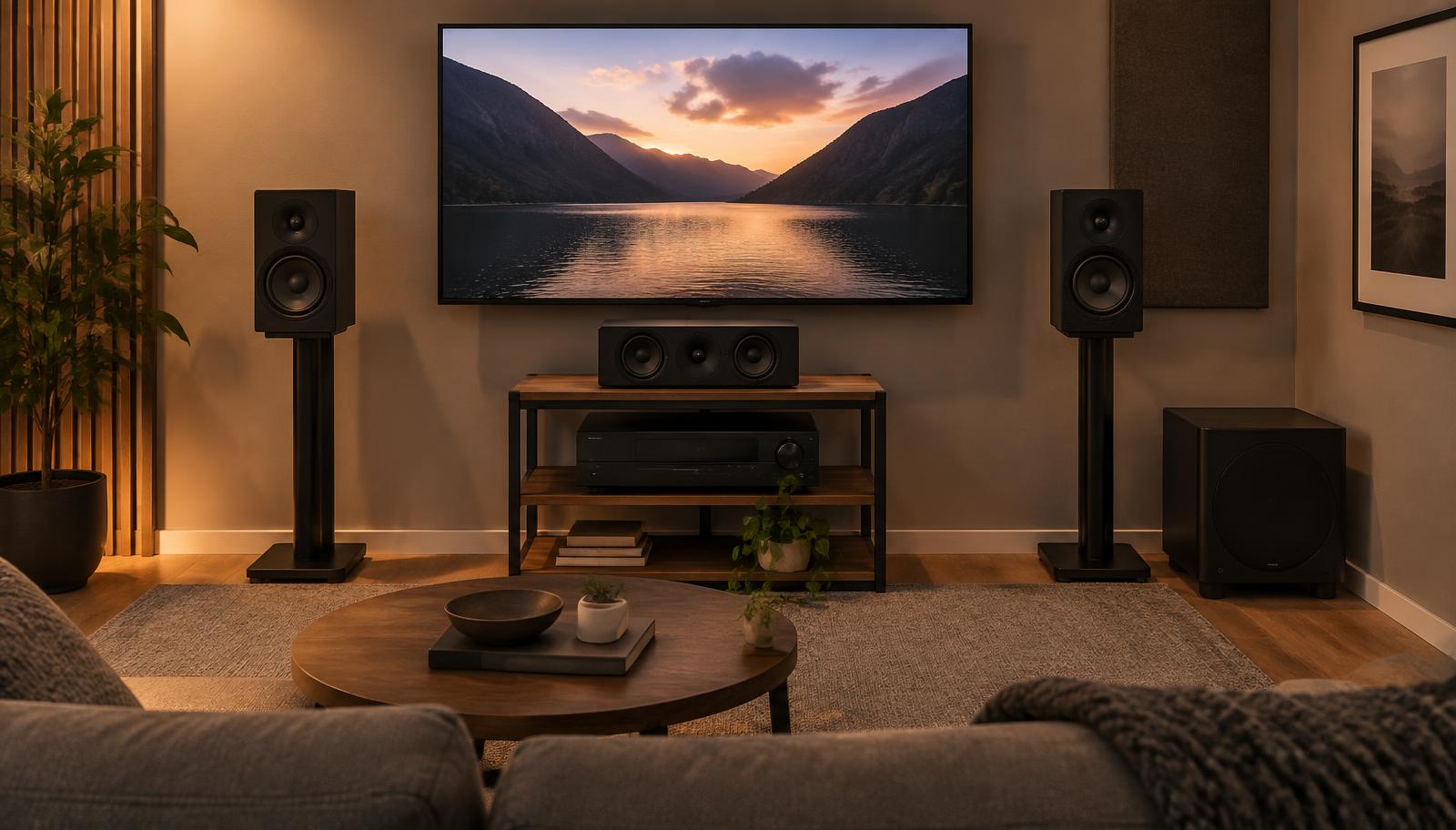
Compact media room with bookshelf speakers on stands, centre channel, subwoofer and AV receiver
    Polk Audio · Category

    Polk Centre Channel Speakers

    If dialogue is unclear in a home theatre, the centre channel is nearly always the cause — and usually its placement rather than its specification. This page compares Polk's centre models and sets out the placement rules we apply during commissioning.

    What are Polk centre channel speakers?

    The centre channel carries most of the dialogue in a film and much of the on-screen effect work. Polk's centre models differ mainly in driver size and cabinet height — slim, wide designs are made for the gap under a wall-mounted screen, while taller two-way designs suit a media unit. Placement height and tilt affect intelligibility more than the model choice does.

    What Centre Channel Speakers Do in a System

    The centre anchors voices to the screen. It should share the tweeter family of the front left and right so that a sound moving across the front stage does not change character in the middle. Its level and distance settings then determine whether dialogue sits naturally in the mix.

    Polk Centre Channel Speakers Compared

    Values below are Polk's own published figures. Where a specification is not published, the cell reads "Specification currently being verified" rather than carrying an estimate. Each model has its own page with the full specification set, system role and installation notes.

    Manufacturer-published specifications, compared side by side
    ModelSeriesDriversFrequency responseSensitivityDetail page
    ES35Signature Elite1 × 1" Terylene dome tweeter, 6 × 3" mica-fortified polypropylene woofers70 Hz – 40 kHz88 dBView
    ES30Signature Elite1 × 1" Terylene dome tweeter, 2 × 5.25" mica-fortified polypropylene woofers55 Hz – 40 kHz89 dBView
    R400Reserve1 × 1" Pinnacle Ring Radiator tweeter, 2 × 6.5" Turbine Cone woofers36 Hz – 50 kHz overall; 48 Hz – 39 kHz (−3 dB)89 dB (2.83 V / 1 m)View
    R350Reserve1 × 1" Pinnacle Ring Radiator tweeter, 4 × 4" Turbine Cone woofers50 Hz – 50 kHz overall; 75 Hz – 35 kHz (−3 dB)87 dB (2.83 V / 1 m)View
    R300Reserve1 × 1" Pinnacle Ring Radiator tweeter, 2 × 5.25" Turbine Cone woofers45 Hz – 50 kHz overall; 65 Hz – 38 kHz (−3 dB)86.5 dB (2.83 V / 1 m)View
    XT35Monitor XT1 × 1" Terylene dome tweeter, 4 × 3" bi-laminate paper woofers57 Hz – 40 kHz; 84 Hz – 26 kHz (−3 dB)87 dB (1 W / 1 m)View
    T30T Series1 × 1" silk dome wave-guide tweeter, 2 × 5.25" mid/woofers38 Hz – 24 kHz; 40 Hz – 20 kHz (−3 dB)90 dB (1 W / 1 m)View

    How We Choose Between Them

    Selection is a room decision. These are the factors we work through before suggesting a model, in this order:

    • Measure the available height first. A media unit shelf with 12 cm of clearance rules out the taller two-way centres regardless of preference.
    • Match the range of the front left and right speakers.
    • For wide seating arcs, a centre with larger woofers and wider horizontal coverage keeps dialogue consistent for the outer seats.
    • For a wall-mounted screen, a slim wide centre fits the gap without blocking the picture or forcing an awkward tilt.
    • Check the depth against the media unit — a centre pushed flush to the back panel will sound boxy.

    Placement and Calibration

    As close to seated ear height as possible, directly below or above the screen centre line, tilted toward the seats when it sits low, isolated from the furniture, and never inside a closed compartment. A hard glass table directly in front of the centre creates a reflection that smears speech; a cloth runner or rug is a genuinely effective fix.

    Common Mistakes We Are Called In to Fix

    Most of the rooms we are asked to correct have the right equipment installed the wrong way. These are the recurring ones:

    • Hiding the centre inside a closed cabinet with a glass door.
    • Leaving it flat on a low shelf firing at knee height instead of tilting it toward the seats.
    • Setting the centre level by ear at low volume and never rechecking it with dialogue-heavy content.
    • Using a centre from a different range than the front left and right.

    How LiveInSmart Reviews This Information

    Specifications on this page are taken from Polk Audio's own published product information and are re-checked before each content update. Where a value is not published by the manufacturer, we leave it out rather than estimate it — you will see "Specification currently being verified" instead of a guessed number. Everything else on this page is LiveInSmart's own system-design and installation guidance, written by the engineers who commission these rooms.

    • LiveInSmart Technologies is an authorised Polk Audio dealer in Telangana and Andhra Pradesh, and a home theatre, AV, acoustics and smart-home integrator working across both states since 2018.
    • Our authorised-dealer status applies to Polk Audio in Telangana and Andhra Pradesh. Product recommendations still begin with the room, listening requirement and system design rather than a catalogue.
    • Speaker choice is always validated against the room: dimensions, listening distance, seating layout, ceiling construction, amplification and acoustic treatment.
    • Our commissioning routine includes level and distance setting, crossover and bass management, subwoofer positioning, room correction and a listening check with reference material.
    • Experience centres in Ameerpet (Hyderabad) and Ashok Nagar (Vijayawada) let you hear layout differences before committing to a design.
    Experience Centre · Hyderabad

    Visit our Hyderabad showroom

    Book a free demo at the LiveInSmart Hyderabad Experience Centre — listen to Dolby Atmos, see 4K laser projectors and walk through live home-automation scenes before you buy.

    Pancom Business Centre, Mumbai Hwy, Nagarjuna Nagar Colony, Ameerpet, Hyderabad 500073

    Frequently Asked Questions

    Why is dialogue unclear in my home theatre?+

    In most rooms it is centre placement, level or crossover — not speaker quality. Check height and tilt first, then the calibrated distance and level, then room reflections around the screen.

    Should the centre be above or below the screen?+

    Whichever puts it closer to ear height. Below the screen with a slight upward tilt is the most common workable arrangement.

    Can I use a bookshelf speaker as a centre?+

    Upright, yes, if it fits and matches the fronts. Laying a bookshelf speaker on its side changes its horizontal dispersion and usually harms dialogue for the outer seats.

    Do I need a centre channel at all?+

    For a multi-channel film system, yes. A phantom centre from two speakers only holds for a listener sitting exactly in the middle.

    What crossover suits a centre channel?+

    Usually higher than the front left and right, because centre cabinets are smaller. Set it during calibration, checking male dialogue for chestiness or thinness.

    Design a Polk Audio System For Your Room?

    As an authorised Polk Audio dealer in Telangana and Andhra Pradesh, we can help with product selection, system design, installation and calibration. Send us your room dimensions, seating position, ceiling type and how you use the room for a room-appropriate configuration.

    Plan My Polk Audio System